
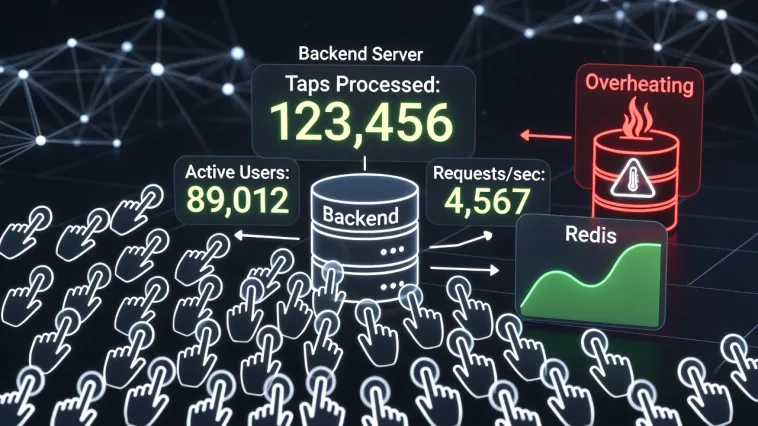
Telegram tap games look incredibly simple.
A player taps a button.
Their score increases.
That’s it.
But once a few thousand players join, many of these games suddenly start lagging…or crashing completely.
The surprising part is that the problem usually isn’t the game logic or the frontend.
It’s the backend architecture.
After building several tap-style games, I’ve noticed the same issue over and over: developers underestimate how much noise a tap game actually generates.
And when that noise hits a traditional database, things start to fall apart.
The Hidden Scaling Problem in Tap Games
Tap games generate a huge number of write operations.
Imagine this scenario:
- 2,000 players online
- each player tapping about 10 times per second
That means your backend is suddenly dealing with:
20,000 writes per second
And that’s just taps. Not including:
- leaderboard queries
- player state updates
- login sessions
- cooldown timers
Many developers initially store all tap data directly in a relational database like PostgreSQL or MySQL.
During testing, this works fine.
But once real users arrive, the database quickly becomes the bottleneck.
Why Databases Start Struggling
Traditional databases are designed for reliability and long-term storage.
They are not optimized for extremely high-frequency writes like tap events.
When every tap becomes a database update, several problems start to appear:
Disk I/O pressure
Each write requires disk operations, which are far slower than memory operations.
Row locking
Multiple players updating scores simultaneously can cause contention.
CPU spikes
Handling thousands of concurrent queries increases CPU usage dramatically.
Connection limits
Your database server may run out of available connections.
At first the symptoms are subtle:
- slightly delayed taps
- leaderboard lag
- occasional slow requests
But as player counts grow, the entire system can become unstable.
The Redis Approach
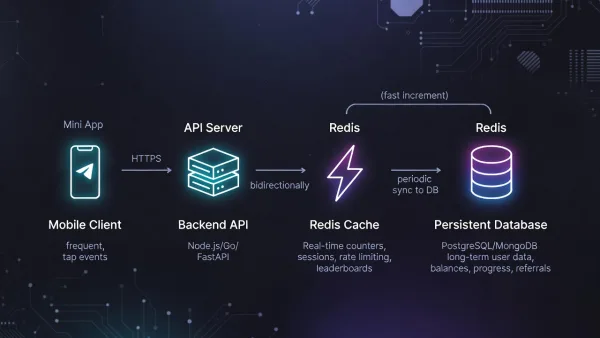
This is where Redis becomes extremely useful.
Redis is an in-memory data store, meaning it keeps data in RAM rather than writing every operation directly to disk.
Because of this, Redis operations often take less than one millisecond.
That makes it ideal for handling extremely frequent updates like tap events.
Instead of writing every tap directly to your database, you can route those updates through Redis first.
Conceptually, the flow looks like this:
Player taps
   ↓
Game API
   ↓
Redis counter
   ↓
Database (periodic save)
Redis absorbs the high-frequency traffic, while the database stores the long-term data.
Why This Architecture Scales Better
Using Redis changes the workload dramatically.
Instead of your database handling tens of thousands of writes per second, it might only receive periodic updates.
For example:
- Redis updates player scores in real time
- every few seconds, the backend saves aggregated results to the database
This approach dramatically reduces database load while keeping the game responsive.
Players see instant feedback, while the system remains stable.
Redis Makes Leaderboards Easy
Another advantage of Redis is its built-in data structures.
Redis supports sorted sets, which are perfect for leaderboards.
A simplified example might look like this conceptually:
player score → leaderboard ranking
Redis can update and retrieve rankings extremely quickly, which means you can generate live leaderboards without heavy database queries.
For tap games where rankings change constantly, this becomes incredibly useful.
Example Backend Architecture
A scalable tap game backend often looks something like this:
Telegram Mini App
        ↓
Game API server
        ↓
Redis (real-time counters)
        ↓
Database (long-term storage)
The frontend might run inside Telegram as a mini app, while the backend handles tap events and player data.
Redis manages the high-frequency updates, and the database remains responsible for persistent storage.
Why Many AI-Generated Games Miss This
Recently, a lot of developers have started using AI tools to generate simple games quickly.
This works well for prototypes.
But many of these automatically generated backends follow a simple pattern:
tap → write to database
tap → write to database
tap → write to database
That architecture works fine with:
- 10 players
- 50 players
- maybe even 100 players
But once the game becomes popular, the system quickly hits scaling limits.
Without some form of high-speed caching or buffering layer, the database becomes overwhelmed.
Lessons From Building Tap Games
One of the biggest lessons from building tap games is that simple mechanics can generate massive backend traffic.
Even a basic tapping game can produce:
- tens of thousands of updates per second
- constant leaderboard recalculations
- heavy player state updates
Using Redis as a real-time buffer allows the system to absorb this traffic efficiently.
It keeps gameplay responsive while protecting the database from overload.
Final Thoughts
Tap games look simple on the surface.
But once thousands of players join, the backend becomes a real engineering challenge.
A database alone often isn’t enough to handle the load.
Adding Redis as a high-speed caching and counter layer is one of the simplest ways to make a tap game architecture far more scalable.
For developers building Telegram tap games, understanding this early can save a lot of headaches later.