The Government Found a Way to Tax Nothing
You know what’s amazing about the U.S. tax code? It somehow found a way to tax zero dollars.
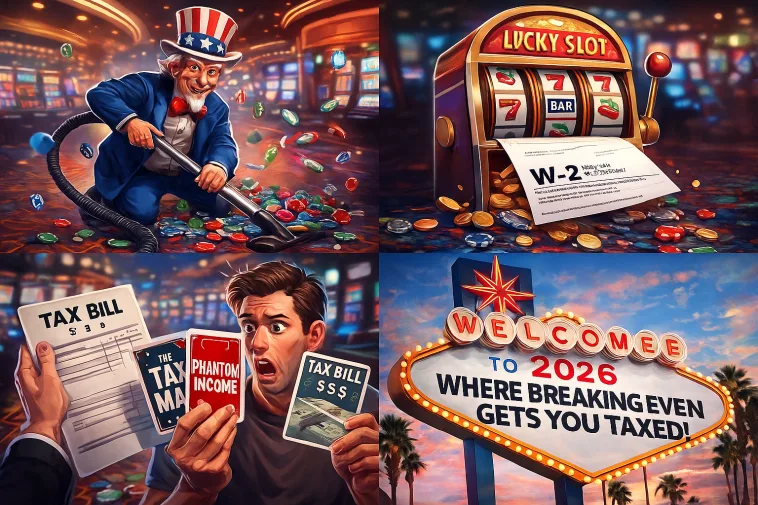
Under the One Big Beautiful Bill Act (which, I swear, sounds like it was named by a drunk marketing intern), if you win and lose the exact same amount gambling in 2026, you’ll still owe taxes. Why? Because the IRS will only let you deduct 90% of your losses.
Let’s do the math. You win $100,000. You lose $100,000. Congrats, you made zero. Except now the IRS says, “Well actually, you made $10,000. That’s taxable.”
It’s called phantom income, and no, it’s not a new horror movie. It’s just a terrifyingly stupid tax policy.
The Deadline to Not Get Screwed: December 31, 2025
Let’s make this simple. If you gamble and you itemize deductions, your last responsible bet is on or before December 31, 2025. After that, the tax math gets dumber than a blackjack player hitting on 20.
Here’s what happens:
- In 2025, you can still deduct 100% of your gambling losses up to your winnings. Break even? No tax.
- In 2026, you can only deduct 90%. Break even? Taxable income. Because apparently, that’s how we do logic now.
Who’s About to Regret Their Life Choices?
- People who itemize: You are now officially on the IRS’s “don’t worry, we’ll still get paid” list.
- High-volume gamblers: The house always wins, and now the government gets a piece too.
- Pros: If you’re a professional gambler, I hope you enjoy explaining phantom income to your accountant. And therapist.
- Casual gamblers who don’t itemize: You’re safe. Sort of. You were already being taxed on your gross winnings without deducting losses. This law just confirms that yes, the system still doesn’t care about your $200 FanDuel addiction.
Casinos Are Freaking Out, Just Not Publicly
The big online casinos know what’s coming. They just can’t say it out loud without tanking their own stock prices.
But industry insiders and lawmakers from gambling-heavy states (looking at you, Nevada) are pushing back hard. The American Gaming Association called the law “disruptive,” which is PR-speak for “this is going to hurt like hell.”
If you’re wondering why they’re mad, it’s not because they care about your tax bill. It’s because high-stakes gamblers are now being told, “Hey, your break-even year? That’ll be $12,000 to the IRS.”
What do you think high-stakes gamblers do when they find out legal casinos are a tax trap? They go somewhere else. Like the illegal, offshore, zero-regulation, “tell-your-bank-it’s-a-t-shirt” kind of somewhere else.
Which means this new rule might actually reduce federal revenue, hurt legal businesses, and send money to shady international markets.
Great job, everyone.
“But They Didn’t Send Me a Tax Form, So How Would the IRS Know?”
Oh, you sweet summer child.
You think just because your online casino didn’t send you a W-2G, the IRS can’t figure it out? They have data analytics, bank tracking, and algorithms that can tell when you Venmo’d someone for “pizza” but it was actually rent.
Let’s break it down:
- Online casinos report you if you hit the jackpot thresholds.
- If you’re using your player account, your activity is logged. If you withdraw, the money hits your bank account. If the deposits don’t match your reported income, you’ve just signed up for a special invite-only event: an audit.
- And yes, whistleblowers are real. The IRS literally pays people to snitch on tax cheats. Don’t be surprised if it’s your ex.
So sure, you could try not reporting. But the risk isn’t worth it. Unless your dream is explaining online roulette to a federal agent.
What’s the Smart Move?
If you gamble and itemize deductions, the smartest move is this:
Gamble all you want before December 31, 2025. Then quit.
Why? Because that’s the cutoff. Every win and loss after that gets treated with the new math. And the new math hates you.
So if you enjoy gambling, just stop by the end of the year. That way, you can break even without a surprise tax bill.
You know, the way it worked when the world made a little more sense.